


Energizing Every Moment
By Harlee Johnson
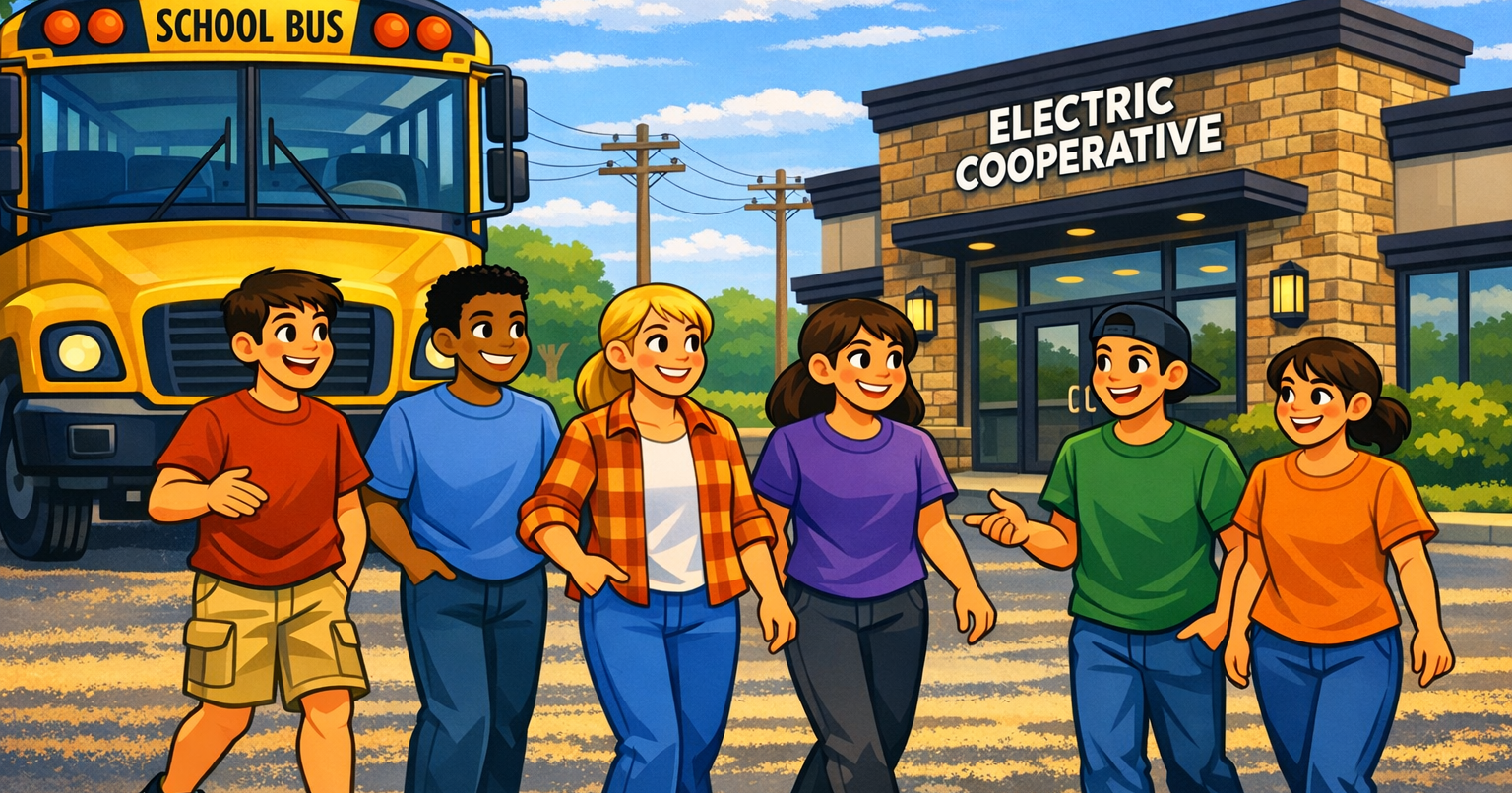
“Seatbelts, everyone!” Ms. Frizzle shouts as the Magic School Bus rolls out of the school parking lot. We are going to town this time. The Magic School Bus is not going to shrink or float through space. Ms. Frizzle says we are going on a field trip to learn about cooperatives. She called them co-ops, for short.
I got on the Magic School Bus not knowing what a co-op was. Ms. Frizzle told us that cooperatives are businesses owned by the people who use them. The goal of the cooperative is not to make money but to help the community.
The first place we visited was the electric cooperative. The bus stopped next to a building that had a lot of power lines around it. An employee came out to meet us, and he explained how they give electricity to people’s homes, to schools, to hospitals, and to farms.
The worker was very helpful. He said that the people who live in the community are part of the co-op. These people are co-op members, who get to vote on big decisions that affect the co-op. Ms. Frizzle called this member control. The employee explained to us that it is important to have energy that you can count on, especially when there are storms.
When the power goes out, the workers from the co-op can get to the problem because they live close by. This means they can fix the problem quickly and get everything working again. Without electricity, everything stops working. There are no lights, no heating or cooling, and no medical equipment that people might need. I was thinking about how we use electricity every day. It made me see how important the co-op really is.
Our next stop was the library. There were students working on their laptops and looking for books on the shelves. The co-op made it possible for people in rural areas to have internet.
Ms. Frizzle told us that big internet companies usually do not bother with small towns like ours because they do not bring enough money from them. But co-ops are different; they care about the people who live in these towns. With broadband internet, students can do their homework, people can work from their homes, and they can even get medical help online. This is important because it helps people learn things and get the information they need, which is something that co-ops believe in. They call it education, training and information.
The third place we visited was a community center, where we met teens who were the same age as us. They were taking part in a youth leadership program that the co-op was running for them. The students learned leadership skills, public speaking, and even attended co-op board meetings. Some of the students are applying for scholarships through the co-op to help pay for their college.
One of the students told us that the co-op wants young people to stay involved and eventually lead the community. This shows that the co-op really cares about the community, and they are already thinking about the future, not just what is happening now. The co-op is thinking about how the community will be and wants the students to be a part of it.
Our last stop was at a coffee shop. The manager told us how the co-op helps businesses like theirs come to town. The co-op makes sure they have energy and internet which is important. When we have businesses in town, job opportunities are created. That is beneficial for our community because it helps it grow and get stronger financially.
Ms. Frizzle said this is an example of how people who are part of the co-op can help the community economically. When people put their money into the co-op, the good things that happen stay here in our community. The money helps make new things possible for everyone
who lives in our community. The coffee shop and the co-op are a team, creating benefits for everyone.
On the way back to school, dark clouds came in and a storm started. When I got home, the power was out, but within five minutes the power was back on. This was cool because I now understood what was happening. I learned how different electric companies work together to help each other when bad things happen. The electric company calls this cooperation among companies, and it helps keep people in our community safe and connected.
I explained to my parents that I had learned about this on our field trip. Co-ops energize every moment by powering our homes, connecting us through the internet, creating job opportunities, and supporting young leaders. They’re not just companies, but neighbors helping neighbors.
After the whole explanation, I told my parents, “And that, Mom and Dad, is the power of cooperation.”
Harlee Johnson is a rising senior at Obion County Central High School. Her “Energizing Every Moment” short story was chosen as the overall winner for Gibson Electric Membership Corporation. She will now compete at the state level for one of three scholarships. Johnson’s story also earned her a spot on the 2026 Washington Youth Tour. Learn more: https://www.tnelectric.org/youthtour/