

Services that enhance our communities
Get help with energy bills
Please note: Gibson Electric is not involved in the application process or in distributing LIHEAP funds. All applications and decisions are handled directly by the appropriate state and local agencies.
Applications for Low-Income Home Energy Assistance Program (LIHEAP) are being accepted in Tennessee and Kentucky. This federally funded grant program aims to assist low-income households in meeting their immediate energy needs.
In Tennessee, LIHEAP is administered through a network of 19 local agencies that reach all 95 counties. It is one-time assistance offered to help defray heating and cooling expenses, as long as funding is available. The LIHEAP assistance amount will range from $174 to $750 depending on household energy burden.
Applications and all necessary forms must be submitted via SmartSimple. If you need assistance, the agency serving your county can help you with your application. Gibson Electric members who live in Crockett, Dyer, Gibson, Lake or Obion counties should contact the Northwest Tennessee Economic Development Council at (731) 364-3228.
Gibson Electric members who live in Haywood and Madison counties should contact the Southwest HRA at (731) 989-5111.
Gibson Electric members who live in Lauderdale County should contact the Delta Human Resources Agency at (901) 476-5226.
Tennesseans can visit https://thda.org/help-for-homeowners/low-income-home-energy-assistance-program-liheap/ for more information.
In Kentucky, LIHEAP is administered through local Community Action Agencies and is available in all 120 counties. Winter Crisis applications are accepted on a first-come, first-serve basis through March 27, 2026. Applications are submitted through local Community Action Agencies. Gibson Electric members who live in Kentucky should call 800-456-3452 or visit www.capky.org/network to locate their local office.
Enter to win the Winter Wonder List Sweepstakes
Ready to make your winter one to remember? TVA EnergyRight is giving you the chance to win big just for taking smart steps toward energy savings.
Complete your free DIY Home Energy Assessment by March 8, 2026, and you’ll be automatically entered for a chance to win our Winter Wonder List prize pack (worth $600):
 Gourmet Pizza Oven
North Face Gloves
Fujifilm Instax Mini 41
7qt Crockpot
Kindle Basic
Smokeless Fire Pit
You’ll also fetch a free energy-saving kit and a $10 gift card just for completing your assessment.
It’s fun, fast and the perfect way to check energy savings off your Winter Wonder List while making your home more efficient for the season ahead. Enter to win at https://energyright.com/winterwonderlist/
Working together to lower demand
When outdoor temperatures drop, electricity use naturally rises.
Colder weather drives us indoors, where we rely more heavily on home heating systems and more lighting. Heating systems run longer and more frequently to maintain comfortable indoor temperatures. Combine that with the fact that most people use electricity at the same times — typically in the mornings and early evenings — and the result is significant pressure on our electric grid.
Gibson Electric Membership Corporation works closely with the Tennessee Valley Authority, our generation and transmission company, to plan for these seasonal weather patterns and changes. This partnership involves detailed resource and infrastructure planning to make certain electricity is available whenever you need it. However, it’s important to remember that our local system is part of a much larger regional and national electric grid.
During the winter months, when homes and businesses across the country are using more electricity simultaneously, overall demand can approach or occasionally exceed available supply. This is especially true during severe weather events such as ice storms or sudden temperature drops. In rare cases when demand threatens to outpace supply, TVA might call for controlled outages (rolling blackouts) to prevent broader system failures. If such a situation arises, Gibson Electric will provide you with timely updates.
Help us maintain a reliable grid by taking simple actions during periods of high electricity use, especially on the coldest days of winter:
- Lower your thermostat slightly. Even reducing the temperature by a few degrees can help.
- Delay using large appliances during peak hours, which are typically 4 a.m. to 10 a.m. Run dishwashers, washing machines and dryers during off-peak hours.
- Adjust your water heater. Setting it to 120 degrees and spacing out showers helps conserve both energy and hot water.
- Unplug unnecessary devices. Power used for lighting and electronics adds up and accounts for a significant portion of home energy use. Disconnect unused items to reduce energy waste.
By practicing these energy conservation habits at home, you save money on your monthly bill and help strengthen the resiliency of the grid that powers our communities. Thank you for helping us ensure our local grid continues to serve us reliably throughout the season.
Dan Rodamaker announces retirement
After 22 years of service, Gibson Electric and Gibson Connect President and CEO Dan Rodamaker has announced his retirement effective May 1, 2026.
Rodamaker joined Gibson Electric Membership Corporation in August of 2003.
“It has been my honor and privilege to serve the members, employees and the board of trustees of Gibson Electric Membership Corporation,” Rodamaker said.
Notably, Rodamaker led Gibson Electric to form its broadband subsidiary in 2017. Since that time, Gibson Connect has provided high-speed internet access to the cooperative’s member-owners.
“We are happy we can deliver this essential service and bridge the rural divide for our Northwest Tennessee and Western Kentucky members,” Rodamaker said. “I’ve truly been blessed by the relationships with those who work in the cooperative family.”
Rodamaker and his wife, Kim, make their home in Trenton. They have three children and 11 grandchildren. The Gibson Electric and Gibson Connect Board of Trustees is in the process of selecting the next president and CEO.
‘Concern for Community’
From supporting nonprofit organizations to spending time with seniors, Gibson Electric Membership Corporation lives out the cooperative principle of concern for community.
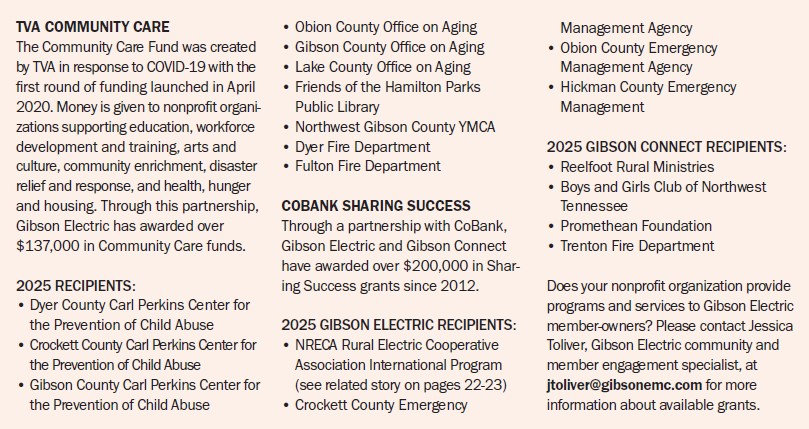
To celebrate October as National Co-op Month, Gibson Electric held member appreciation events at each member service center, delivering $160,000 in matching funds to local nonprofits. These TVA Community Care, TVA economic development and CoBank Sharing Success grants support a wide range of services that enhance our members’ quality of life.
“Communities thrive when local services are strong,” said Gibson Electric and Gibson Connect President and CEO Dan Rodamaker. “These grants help ensure that food assistance, emergency response and educational resources are available when our members need them most.”
In October, the Tennessee Electric Cooperative Association encouraged its member co-ops to participate in the Tennessee Electric Co-op Day of Service on or around Oct. 16. Gibson Electric chose a multi-day project that saw employees visiting senior citizen centers and offices on aging across our Tennessee service area for rousing bingo games. Employees also donated game prizes.
“Senior Bingo was as much fun for us as our hosts,” said Gibson Electric Community and Member Engagement Specialist Jessica Toliver. “We’ve been invited back to call more bingo numbers, check more bingo cards and share more laughs.”
While “Concern for the Community” was in the spotlight in October, it’s dear to our hearts throughout the year.
“Living out the cooperative spirit means showing up, and our employees and members do it every day,” Rodamaker said. “We are blessed serve to communities where neighbors truly care for one another.”
Energizing your holidays
As the year winds down and December rolls in, we find ourselves surrounded by twinkling lights, familiar songs and the quiet hum of anticipation. Gibson Electric Membership Corporation is honored to energize every moment of your holiday season.
We know this season can be joyful, but it can also be complicated. Not every home is bustling with activity, and not every tradition looks the same. For some, the holidays are a season of celebration. For others, they are a time of reflection, remembrance or simply rest.
That’s the beauty of our communities: they are made up of many stories, many rhythms and many ways of finding light in the darker months. Our season’s greetings may sound different, but we are bonded by our shared experiences.
Our employees live in the same communities we serve. We shop at the same stores, cheer at the same ballgames and greet each other in the same checkout lines. Our relationships with you—our members—are rooted in trust, and we don’t take that lightly.
Our members are at the heart of everything we do. Your support fuels our mission, and your continued engagement helps shape the future of our cooperative. Serving you is our privilege.
This season, whether you’re stringing lights across your porch, attending a school play or hosting a dinner with friends, Gibson Electric and Gibson Connect power the moments that matter. It’s easy to overlook, but behind every cozy gathering and flicker of warmth, our team is working to keep your electricity and internet reliable.
Our commitment to keeping you energized and connected doesn’t pause for the season. Even on holidays, our lineworkers and fiber installation/repair technicians are on call to respond to outages, and our staff answer your calls with care. We take pride in being available when you need us most, diligently working so your celebrations can shine.
As we look ahead to a new year, we invite you to join us in reflecting on the challenges faced and the milestones celebrated. May they inspire all of us us to keep improving, keep listening and keep showing up with the kindness and compassion our families and communities deserve.
Gibson Electric is more than your utility provider. We’re your neighbor, your partner and your advocate. We’re proud to energize your holidays—whatever they look like—and every day beyond.
Merry Christmas and Happy New Year from all your friends at Gibson Electric!
Lighting up your Christmas
If you’re driving down North Old Troy Road in Union City this December, don’t be surprised if you find yourself slowing down — or stopping altogether — to take in the dazzling spectacle at house number 1777.
Inspired by Clark Griswold’s over-the-top holiday spirit in “Christmas Vacation,” Gibson Connect Fiber Installation/Repair Technician 2 Mitch Eddington decorates his house and yard with millions of Christmas lights and 40 inflatables each year.
“When I was a kid, I remember riding around with my parents to see Christmas lights, and there was always that one house we just had to go see,” Mitch said. “I want to be the house that the kids look forward to seeing each year.”
For many families in Union City and Obion County, a visit to Mitch’s house has become a cherished part of their holiday season.
Mitch has always loved Christmas, but he didn’t start decorating for his favorite holiday until after he got married and purchased his first home. He and his wife have been married 15 years, and their children are aged 12, 10 and seven.
Preparing their home and yard for the annual celebration is not a team game though.
“I’m too picky,” Mitch joked.
Setting up takes about a month so Mitch gets started in October, working after hours and weekends. There are elements that remain the same from year to year to ensure everything works properly, but he tries to change as much as he can to keep the display fresh.
He sticks with traditional-style lights because those are his favorites. The lights are synchronized to music.
His biggest challenge is finding the time and a power source to get it all done.
When another Christmas has passed, Mitch begins the dreaded task of cleaning up. He has a shed dedicated for storing his decorations.
“I’m always excited to put them up, so for me, taking them down is sad,” Mitch said.
While the lights are up, Mitch and his family get a kick out of watching cars drive slowly to take it all in. Some folks even park their vehicles in Mitch’s driveway to enjoy the show as long as possible. He’s grateful for their support, offering this message to them: “Thank you for taking the time out of your busy life to come enjoy a Christmas tradition.”
Whether you’re a longtime fan or a first-time visitor, Mitch’s Christmas wonderland at 1777 North Old Troy Road in Union City is sure to brighten your season.
Count your blessings
A message from Gibson Electric and Gibson Connect President and CEO Dan Rodamaker
Thanksgiving is one of my favorite holidays — delicious food, spending time with family and watching football.
Even in the rush of travel or hosting your family’s celebration, November gives us two powerful reminders: to pause and reflect.
On Veterans Day, we honor the brave men and women who have served our country. We are especially proud to recognize our employee veterans and our member veterans.
At Thanksgiving, we count our blessings — including the freedoms their service has helped protect.
I’m reminded of the Irving Berlin song from “White Christmas,” which perfectly fits Thanksgiving: “Count Your Blessings (Instead of Sheep).” If indigestion or the stress of the season keeps us up at night, we can, as the song says, fall asleep counting our blessings.
Our blessings here at Gibson Electric Membership Corporation are indeed abundant. Every time I plug in the coffee pot, take a picture on my phone, stream a show on TV or simply turn on the lights, I’m grateful for the forward-thinking leaders who founded our co-op in 1936.
Even today, in a much more urbanized society, co-ops fulfill a mission that would look daunting to other kinds of utilities. Did you know that investor-owned utilities have an average of 35 customers per mile of line, whereas electric co-ops serve an average of just seven members per mile? Co-ops cheerfully do more with less — and I’m so grateful for what we accomplish every day.
We couldn’t do it without our great team. From engineering, linework and fiber services to accounting, member services, technical support, communications and more, all of us at Gibson Electric are aligned with the mission of providing safe, affordable and reliable electricity and internet services. We know how important this work is, and I’m grateful to be surrounded by people who take it as seriously as I do.
Most importantly, I’m grateful for our member-owners. Thank you for trusting us to provide electricity and internet to your homes and businesses. Thanks for engaging with us, supporting our community initiatives and taking ownership of your cooperative. It’s our honor to work with you to enhance the quality of life in the communities we serve.
As you prepare for the holidays, I hope you’ll take a moment to count your blessings. Whether you count them in whispered prayers as you drift off to sleep, write them in your journal or make a mental list, do like the old hymn says and name them one by one.
Happy Veterans Day and happy Thanksgiving from all your friends at Gibson Electric!
LIHEAP applications open in Tennessee and Kentucky
Please note: Gibson Electric is not involved in the application process or in distributing LIHEAP funds. All applications and decisions are handled directly by the appropriate state and local agencies.
Application windows for the Low-Income Home Energy Assistance Program (LIHEAP) opened Nov. 1, 2025, in Tennessee and Nov. 3, 2025, in Kentucky. This federally funded grant program aims to assist low-income households in meeting their immediate energy needs.
In Tennessee, LIHEAP is administered through a network of 19 local agencies that reach all 95 counties. It is one-time assistance offered to help defray heating and cooling expenses, as long as funding is available. The LIHEAP assistance amount will range from $174 to $750 depending on household energy burden.
Applications and all necessary forms must be submitted via SmartSimple. If you need assistance, the agency serving your county can help you with your application. Gibson Electric members who live in Crockett, Dyer, Gibson, Lake or Obion counties should contact the Northwest Tennessee Economic Development Council at (731) 364-3228.
Gibson Electric members who live in Haywood and Madison counties should contact the Southwest HRA at (731) 989-5111.
Gibson Electric members who live in Lauderdale County should contact the Delta Human Resources Agency at (901) 476-5226.
Tennesseans can visit https://thda.org/help-for-homeowners/low-income-home-energy-assistance-program-liheap/ for more information.
In Kentucky, LIHEAP is administered through local Community Action Agencies and is available in all 120 counties. Fall Subsidy applications are accepted on a first-come, first-serve basis until Dec. 12, 2025. Applications are submitted through local Community Action Agencies. Gibson Electric members who live in Kentucky should call 800-456-3452 or visit www.capky.org/network to locate their local office.
Services that enhance our communities
From its origins as a refuge for young men to its modern-day focus on health and wellness, the YMCA has been building stronger communities across the country for generations.
Locally, the Northwest Gibson County YMCA provides essential services to meet the needs of Trenton, Dyer, Rutherford, Yorkville and beyond. In celebration of National Co-op Month in October and Gibson Electric Membership Corporation’s annual member appreciation events, the YMCA is receiving one of 10 matching TVA Community Care grants from Gibson Electric.
Brooke Carrell, who recently marked her one-year anniversary as branch executive director, said the YMCA would use the funds for its suite of kids’ programs, which includes water safety, swim lessons and YPlay sports.
“Our kids’ programs are close to my heart,” Carrell said.
Over the summer, YMCA swim instructors taught water safety and swim lessons to more than 200 local children. The Y also fielded a competitive swim team and sent its lifeguards to the Lifeguard Olympics, where they placed fifth out of 12 YMCAs and received the highest ranking – Superior – in the multi-rescue scenario. YPlay sports like indoor soccer, volleyball and flag football are growing, and youngsters are learning healthy habits early in fun fitness classes.
While kids hold a special place in Carrell’s heart, she is equally committed to providing “something for everybody” at the Y. The Active Older Adults (AOA) program promote health and fitness, strengthening social bonds and teaching new skills. In September, the Y started a four-week technology course to help older adults learn how to use the internet, send text messages and set up email accounts. Those classes will eventually be opened to the public.
Although the Northwest Gibson County YMCA has an up-to-date fitness room, group exercise classes and a virtual fitness studio, its mission reaches well past treadmills and free weights.
“We’re a community, and we’re a family,” Carrell said.