


Ready to roll
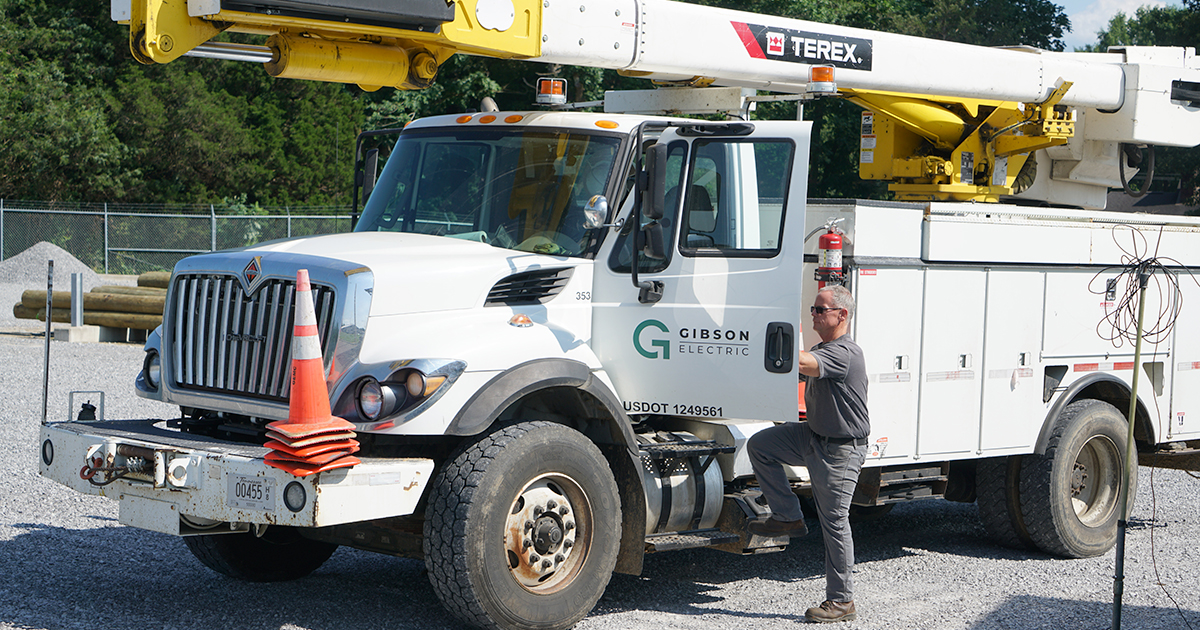
The testing and maintenance behind safe, dependable vehicles
When Gibson Electric and Gibson Connect crews roll out each morning, they know their trucks are ready to go.
Behind the scenes, a steady cycle of testing, maintenance and repairs keeps the cooperative’s fleet in safe, working order. It’s detailed, hands-on work that plays a direct role in protecting employees and serving customers.
Testing for safety
One of the most important steps is dielectric testing, which checks the insulating components on bucket and digger trucks. OSHA requires annual testing, but Gibson goes a step further and performs it twice a year.
Torco Testing Services comes on-site to perform the inspections. During the process, a transformer produces up to 40,000 volts to simulate real-world conditions. The test looks for any voltage or amperage leaks that could put crew members at risk.
Because the testing is done at a lower amperage, it identifies potential problems without damaging the equipment.
Torco staff fully submerge bucket liners in water tanks. While submerged, voltage is applied to check for any amperage leakage and ensure the liners’ insulating properties remain intact.
Ultrasound tools are also used to inspect critical areas such as welds, bolts and pins.
“Torco is looking for anything that could fail,” said Gibson Electric Mechanic Crewleader Philip Jewell. “If something needs immediate attention, we pull that truck out of service and make repairs.”
Noncritical findings are scheduled for the next time the vehicle is in the shop.
Fleet experts
While dielectric and structural testing is handled by a third party, Gibson tests mechanical jumpers, grounding systems and hot sticks in-house. Jewell and fellow mechanics Elliott Bauer and Greg Hunt are also responsible for day-to-day fleet maintenance.
Bucket trucks come in for service every 500 hours, usually two to three times a year, for general upkeep, inspections and any needed repairs. Other vehicles are serviced based on mileage.
Hydraulic leaks and other wear items are among the most common issues the team addresses, but no two days are the same. Mechanics might be working on an engine one day and removing a boom the next.
When new trucks arrive, the team outfits each vehicle with equipment like ladder racks, radios, safety gear and signage before it ever enters service. With about 120 vehicles in the fleet, including around 40 bucket and digger trucks, the shop is constantly moving from one project to the next.
Beyond the trucks, Gibson mechanics also maintain small engine equipment such as hydraulic tools, chainsaws and generators.
Work never stops
Whether it’s a bucket truck, a Wi-Fi trailer or a passenger vehicle, fleet maintenance is ongoing. There’s always another inspection or repair to ensure everything is running safely and reliably.
“The projects never end,” Jewell said.
And that’s exactly the point.
Crews can count on their equipment, and customers can count on crews being ready to perform.